Java + Selenium Automation Testing Course - Career Path, Job Roles & Salary in Chennai
.png)
Software quality is not optional. Companies release updates rapidly through continuous integration pipelines and agile development cycles, so they rely heavily on Automation Testing to maintain reliability and performance.
Among automation stacks, Java with Selenium continues to dominate Chennai's IT job market.
Selenium enables robust web automation and Java provides the stability and object-oriented structure needed to build scalable automation frameworks.
If you are looking for a Java Selenium Automation Testing course in Chennai, this guide outlines the complete career roadmap, relevant job roles, realistic salary outlook, tools covered in training, real-time project methodology and structured placement assistance - without exaggerated promises.
Why Java + Selenium Is Still in High Demand in 2026
Manual testing alone cannot keep up with modern release cycles. Companies integrate automated test scripts into CI/CD pipelines to minimize human error and accelerate deployments.
Java with Selenium remains widely adopted because:
- Selenium is open-source and heavily used across the industry
- Java offers strong community support and mature ecosystem tools
- Teams can integrate it smoothly with Jenkins and CI/CD pipelines
- It enables cross-browser web automation
- It aligns well with Agile and DevOps workflows
Selenium powers web automation, while Java provides the structure and scalability required for building maintainable automation frameworks.
In Chennai, IT service companies, product-based firms, fintech startups, SaaS businesses and healthcare technology organizations actively implement Selenium-based automation frameworks to maintain release quality and speed.
Complete Java + Selenium Automation Testing Roadmap (2026)
A structured Selenium Automation Testing course in Chennai must follow a logical, step-by-step progression. If trainers skip programming fundamentals, they create weak automation engineers who can copy scripts but cannot build or debug frameworks independently.
1. Core Java Programming
Strong Java fundamentals must come before Selenium. If someone jumps directly into automation tools without understanding Java properly, they will struggle to build or maintain frameworks.
The course should cover:
- Java syntax and program structure
- OOP concepts (Inheritance, Polymorphism, Encapsulation, Abstraction)
- Collections framework
- Exception handling
- File handling
- Interfaces
- Basic multithreading
Java forms the backbone of many Selenium automation frameworks. Testers who lack solid Java fundamentals cannot design reusable components, handle exceptions properly or structure scalable test architecture. They end up depending on copied code instead of understanding what they are building.
For additional insights into Java fundamentals for Selenium automation, Learn more about Selenium WebDriver documentation and best practices.
2. Manual Testing Fundamentals
Before jumping into automation, you must understand core software testing principles. Without that foundation, automation becomes blind script writing.
The curriculum should include:
- SDLC and STLC
- Different types of testing (functional, regression, integration, etc.)
- Test case design techniques
- Bug lifecycle management
- Agile methodology
Manual testing knowledge teaches you what to test and why to test it. Automation only handles how to execute it faster. If you skip testing fundamentals, you will automate the wrong scenarios and miss critical defects.
3. Selenium WebDriver
This module forms the core of automation training.
The course should cover:
- Selenium architecture
- Setting up WebDriver
- Using locators (ID, XPath, CSS selectors)
- Handling dropdowns, alerts, and frames
- Implementing synchronization (implicit and explicit waits)
- Managing dynamic web elements
- Performing cross-browser testing
If learners do not practice these areas deeply, they will struggle to automate real-world applications where dynamic elements and timing issues are common.
4. TestNG Framework
TestNG strengthens Selenium automation by adding structure, execution control and reporting capabilities.
The module should cover:
- TestNG annotations
- Test execution control
- Parallel testing
- Reporting and logging
- Data-driven testing with TestNG
TestNG enables testers to build organized, maintainable automation frameworks instead of writing scattered scripts. Without a framework layer like TestNG, automation becomes messy and difficult to scale.
5. Maven & Project Structure
Automation projects require proper dependency management. Without it, frameworks become unstable and difficult to maintain.
The module should cover:
- Maven setup and configuration
- Configuring the pom.xml file
- Managing dependencies correctly
- Understanding the build lifecycle
Apache Maven standardizes project structure, handles libraries efficiently and simplifies build execution. Without structured dependency management, automation projects quickly turn into version-conflict problems and maintenance headaches.
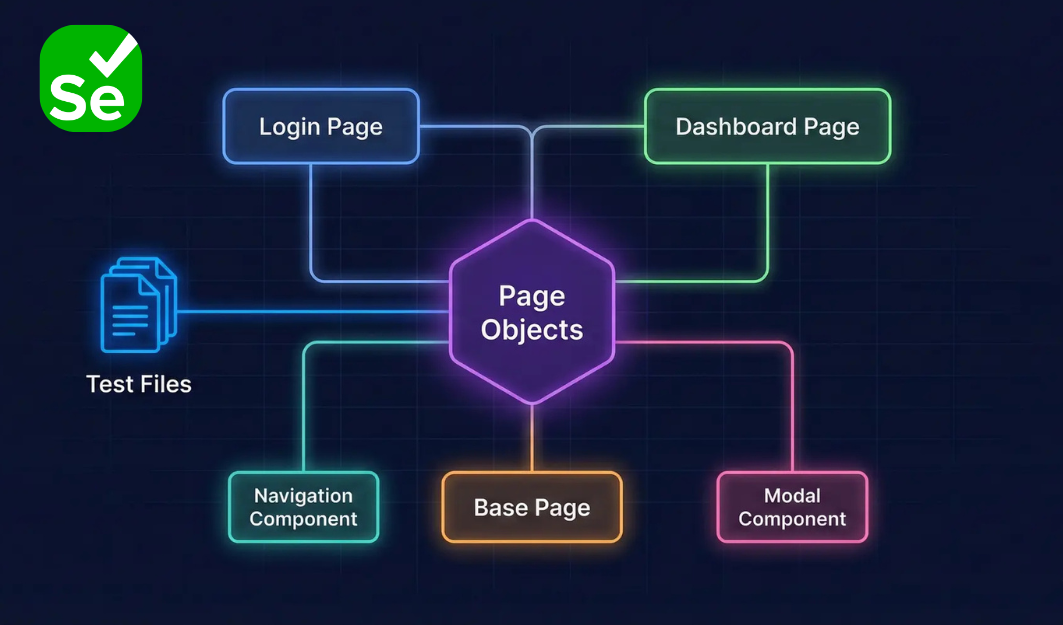
6. Page Object Model (POM) & Framework Design
This module focuses on building scalable and maintainable automation frameworks instead of writing random scripts.
The training should cover:
- Understanding the Page Object Model (POM) concept
- Separating test logic from page elements
- Creating reusable page classes
- Implementing proper folder structure
- Designing modular and scalable frameworks
- Maintaining clean and readable automation architecture
POM reduces code duplication, improves maintainability and makes large automation projects manageable. Without framework design principles, automation becomes chaotic and difficult to scale in real-world projects.
7. API Testing & CI/CD Integration
Modern automation demands pipeline integration. Writing scripts is not enough - teams must run tests automatically within delivery pipelines.
The module should cover:
- API testing fundamentals
- REST API testing with REST Assured
- Jenkins integration
- Continuous testing concepts
- Automated test execution in CI/CD pipelines
Jenkins enables teams to trigger automated test suites within CI/CD pipelines, ensuring every code change passes validation before deployment.
If automation does not integrate into the pipeline, it slows releases instead of accelerating them. Continuous testing turns automation into a business asset, not just a technical activity.
Real-Time Project-Based Training Approach
Structured Java Selenium Automation Testing training in Chennai does not confine learners to predefined demo projects. It prepares them to build automation frameworks independently from scratch.
The program trains learners to:
- Design automation architecture
- Create reusable and maintainable test scripts
- Integrate automation with CI/CD pipelines
- Execute cross-browser testing
- Generate structured automation reports
- Debug real-time production issues
Selenium combined with Java forms the technical basis, but real competence comes from independent execution.
The focus stays on building problem-solving capability, so learners can handle real-time automation projects confidently in professional environments - without depending on copied templates or guided scripts.
Career Opportunities After Java + Selenium Automation Training
After completing a Java Selenium Automation Testing course in Chennai, professionals can apply for roles such as:
- Automation Test Engineer
- SDET (Software Development Engineer in Test)
- Selenium Automation Tester
- QA Automation Engineer
- Test Automation Architect
- Performance Test Engineer
- CI/CD Test Integrator
In Chennai, the following industries actively hire automation testing professionals:
Automation testing skills transfer across domains because every software development team needs reliable test coverage to maintain quality and accelerate releases.
Placement Assistance & Career Support
Professional training institutes provide structured placement assistance, which may include:
- Resume building support
- LinkedIn profile optimization
- Conducting mock technical interviews
- Preparing candidates for coding tests
- Guiding interview scheduling
- Assisting with job referrals
Placement assistance improves interview readiness, but it does not replace skill development. Consistent practice, strong technical fundamentals and real-time project exposure ultimately determine long-term career growth and salary progression.

Java Selenium Automation Testing Career Opportunities 2026